Security Patterns
Comprehensive security patterns implemented across all Integra smart contracts.
Overview
The Integra smart contract system implements defense-in-depth security with multiple independent layers of protection that work together to prevent exploits and maintain system integrity even under attack. This comprehensive security architecture combines battle-tested patterns from OpenZeppelin with custom protections designed specifically for real-world contract tokenization, creating a robust defense against the full spectrum of smart contract vulnerabilities including reentrancy, access control bypass, front-running, and denial-of-service attacks.
Each security layer operates independently to provide redundant protection, ensuring that the failure of any single mechanism does not compromise the entire system. All state-changing functions use reentrancy guards to prevent recursive call attacks, while multi-layer access control combines role-based permissions, attestation-based capabilities, and document-level authorization. The pausability pattern enables emergency shutdowns across all contracts, and the checks-effects-interactions model ensures state updates occur before external calls. Code hash verification in the registry prevents malicious contract upgrades, front-running protection validates attestation recipients, and graceful degradation returns safe default values instead of reverting to prevent denial-of-service. Finally, time-limited emergency controls with progressive expiry provide rapid incident response capability while ensuring eventual complete decentralization.
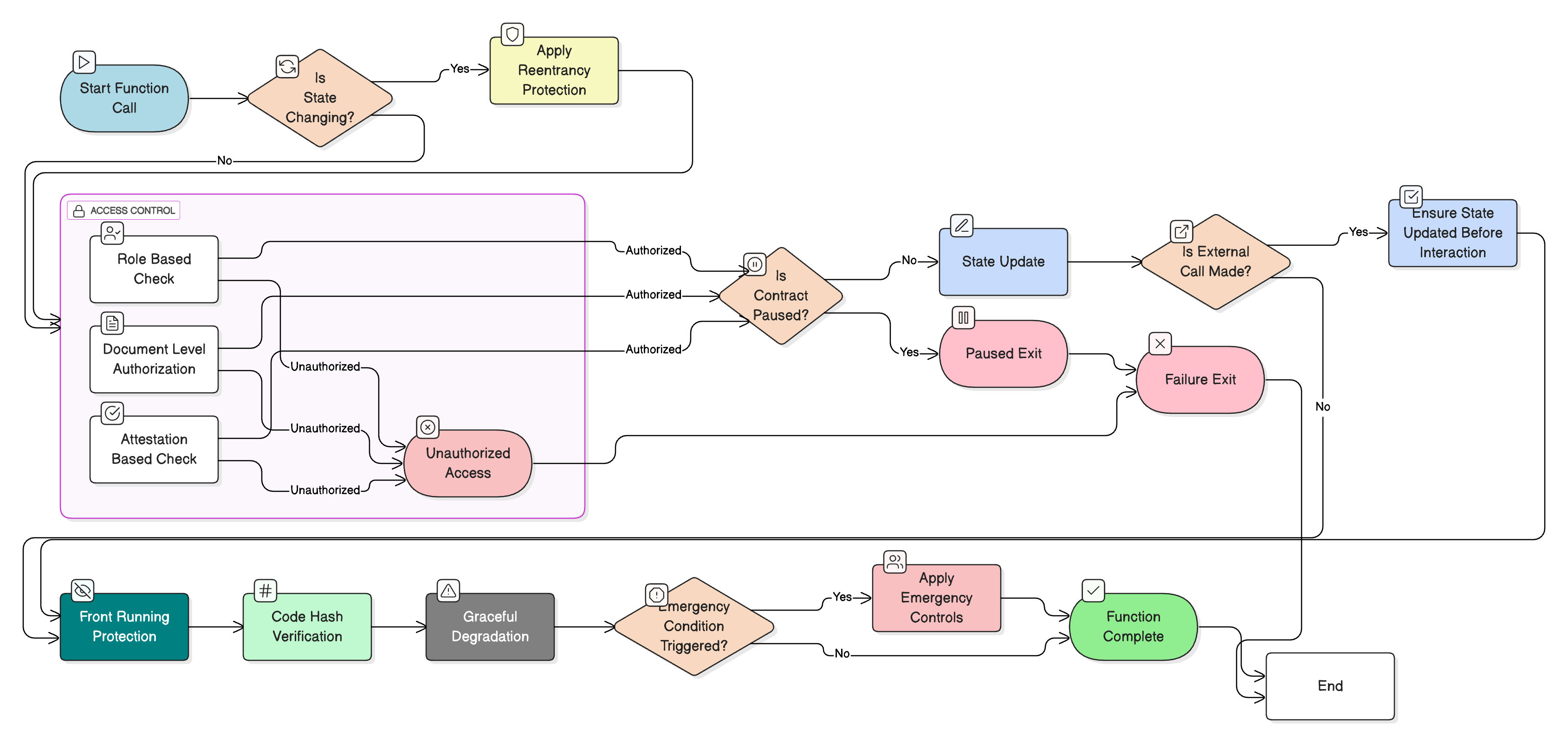
Pattern 1: Reentrancy Protection
Description
All state-changing functions use OpenZeppelin’s ReentrancyGuard to prevent reentrancy attacks. The nonReentrant modifier ensures no function can be called recursively, protecting against malicious contracts attempting to re-enter during external calls.
Implementation
// All contracts inherit ReentrancyGuard
import "@openzeppelin/contracts-upgradeable/security/ReentrancyGuardUpgradeable.sol";

abstract contract AttestationAccessControl is
    UUPSUpgradeable,
    AccessControlUpgradeable,
    ReentrancyGuardUpgradeable,  // ✅ Reentrancy protection
    PausableUpgradeable
{
    // Standard pattern for all state-changing functions
    function _verifyCapability(
        address user,
        bytes32 documentHash,
        uint256 requiredCapability,
        bytes calldata attestationProof
    ) internal nonReentrant whenNotPaused {  // ✅ nonReentrant modifier
        // ... state changes

        // SECURITY: External calls to attestation providers
        (bool verified, uint256 grantedCapabilities) = IAttestationProvider(provider)
            .verifyCapabilities(attestationProof, user, documentHash, requiredCapability);

        // ... validation
    }
}
Benefits
- Complete Protection: Prevents all reentrancy attack vectors
- Zero Trust: No assumptions about external contract behavior
- Gas Efficient: Minimal overhead (~2,600 gas)
- Battle Tested: OpenZeppelin’s proven implementation
Contracts Using Pattern
AttestationAccessControl(Foundation) - All verification functionsIntegraDocumentRegistry(Document Management) - Registration, transfers, executor authorizationBaseTokenizer(Tokenization) - Token reserve, claim, cancel operationsIntegraMessage(Communication) - Message sendingIntegraSignal(Communication) - Payment request operationsIntegraExecutor(Execution) - Meta-transaction execution
Testing Strategy
-
Reentrancy Attack Tests:
- Deploy malicious contract that attempts reentrancy
- Verify all state-changing functions revert with “ReentrancyGuard: reentrant call”
- Test both direct and cross-contract reentrancy
-
Gas Cost Analysis:
- Measure gas overhead of
nonReentrantmodifier - Verify acceptable performance impact
- Measure gas overhead of
Pattern 2: Checks-Effects-Interactions
Description
The Checks-Effects-Interactions pattern ensures state changes occur before external calls, preventing reentrancy and race conditions. Even with nonReentrant protection, this pattern provides defense-in-depth.
Implementation
// TrustGraphIntegration.sol - Example from trust credential issuance
function _issueCredentialsToAllParties(bytes32 integraHash) internal {
    // CHECKS: Validate preconditions
    if (credentialsIssued[integraHash]) {
        return; // Already issued
    }

    // EFFECTS: Update state BEFORE external calls
    credentialsIssued[integraHash] = true;  // ✅ State update first

    // INTERACTIONS: External calls last (wrapped in try/catch)
    address[] memory parties = _getDocumentParties(integraHash);

    for (uint256 i = 0; i < parties.length;) {
        // Try/catch prevents one failure from blocking others
        try this._issueCredentialToParty(parties[i], integraHash) {
            emit TrustCredentialIssued(integraHash, parties[i]);
        } catch Error(string memory reason) {
            emit TrustCredentialFailed(integraHash, parties[i], reason);
        } catch {
            emit TrustCredentialFailed(integraHash, parties[i], "Unknown error");
        }

        unchecked { ++i; }
    }
}
Benefits
- Reentrancy Safe: State updated before external calls
- Non-blocking: Try/catch prevents cascade failures
- Transparent: Events track both success and failure
- Idempotent: Double-issuance prevented by state flag
Critical Locations
- Trust Credential Issuance (
TrustGraphIntegration.sol:182-198) - Resolver Calls (
IntegraDocumentRegistry.sol:1004-1071) - Fee Collection (
IntegraDocumentRegistry.sol)
Pattern 3: Access Control Layers
Description
Multi-layer access control with three security levels:
- Foundation: Attestation-based capabilities (fine-grained permissions)
- Document Management: Document ownership (coarse-grained permissions)
- Tokenization: Per-document executor authorization (delegated permissions)
Foundation: Attestation-Based Access Control
/**
 * @notice Verify caller has required capability via attestation
 * @dev 13-step verification process with front-running protection
 */
modifier requiresCapability(
    bytes32 documentHash,
    uint256 requiredCapability,
    bytes calldata attestationProof
) {
    _verifyCapability(msg.sender, documentHash, requiredCapability, attestationProof);
    _;
}

// 13-Step Verification (EASAttestationProvider.sol:279-402)
function verifyCapabilities(...) external view returns (bool, uint256) {
    // 1. ✅ Fetch attestation from EAS
    // 2. ✅ Verify attestation exists
    // 3. ✅ Verify not revoked
    // 4. ✅ Verify not expired
    // 5. ✅ Verify schema matches
    // 6. ✅ Verify recipient matches (FRONT-RUNNING PROTECTION)
    // 7. ✅ Verify attester is authorized issuer
    // 8. ✅ Verify source chain ID (cross-chain replay prevention)
    // 9. ✅ Verify source EAS contract (EAS spoofing prevention)
    // 10. ✅ Verify document contract (contract spoofing prevention)
    // 11. ✅ Verify schema version
    // 12. ✅ Verify document hash matches
    // 13. ✅ Verify attestation age (optional time limits)
}
Document Management: Document Ownership
// IntegraDocumentRegistry.sol - Three access paths
function getDocumentOwner(bytes32 integraHash) public view returns (address) {
    DocumentRecord storage doc = documents[integraHash];
    if (!doc.exists) revert DocumentNotRegistered(integraHash);
    return doc.owner;
}

// Owner validation in critical operations
function transferDocumentOwnership(
    bytes32 integraHash,
    address newOwner,
    string calldata reason
) external nonReentrant whenNotPaused {
    DocumentRecord storage doc = documents[integraHash];

    // Only current owner can transfer
    if (msg.sender != doc.owner) {
        revert Unauthorized(msg.sender, integraHash);
    }

    // ... transfer logic
}
Tokenization: Per-Document Executor Authorization
// BaseTokenizer.sol - Zero-trust executor model
modifier requireOwnerOrExecutor(bytes32 integraHash) {
    // VALIDATION: Ensure document uses THIS tokenizer
    address documentTokenizer = documentRegistry.getTokenizer(integraHash);
    if (documentTokenizer == address(0)) {
        revert TokenizerNotSet(integraHash);
    }
    if (documentTokenizer != address(this)) {
        revert WrongTokenizer(integraHash, documentTokenizer, address(this));
    }

    // PATH 1: Document owner (highest priority)
    address owner = documentRegistry.getDocumentOwner(integraHash);
    if (msg.sender == owner) {
        _;
        return;
    }

    // PATH 2: Per-document authorized executor (opt-in)
    address authorizedExecutor = documentRegistry.getDocumentExecutor(integraHash);
    if (authorizedExecutor != address(0) && msg.sender == authorizedExecutor) {
        _;
        return;
    }

    // PATH 3: Unauthorized - revert
    revert Unauthorized(msg.sender, integraHash);
}
Security Benefits
- Defense in Depth: Multiple independent validation layers
- Zero Trust: No global privileges, all access explicit
- Front-Running Protection: Recipient validation in attestations
- Owner Sovereignty: Document owner always maintains control
- Flexible Delegation: Opt-in executor authorization
Testing Strategy
-
Attestation Tests:
- Test all 13 verification steps individually
- Test front-running scenarios (wrong recipient)
- Test expired/revoked attestations
- Test cross-chain replay attacks
-
Ownership Tests:
- Test ownership transfer scenarios
- Test unauthorized access attempts
- Test edge cases (zero address, self-transfer)
-
Executor Tests:
- Test opt-in authorization
- Test revocation
- Test wrong tokenizer attacks
- Test EOA vs contract executors
Pattern 4: Pausability
Description
Emergency circuit breaker pattern using OpenZeppelin’s Pausable. All state-changing functions can be paused by governance in case of security issues.
Implementation
import "@openzeppelin/contracts-upgradeable/security/PausableUpgradeable.sol";

abstract contract AttestationAccessControl is
    UUPSUpgradeable,
    AccessControlUpgradeable,
    ReentrancyGuardUpgradeable,
    PausableUpgradeable  // ✅ Pausability
{
    // Pause functions (governance only)
    function pause() external onlyRole(GOVERNOR_ROLE) {
        _pause();
    }

    function unpause() external onlyRole(GOVERNOR_ROLE) {
        _unpause();
    }

    // All state-changing functions use whenNotPaused
    function criticalFunction(...)
        external
        nonReentrant
        whenNotPaused  // ✅ Can be paused
        onlyRole(GOVERNOR_ROLE)
    {
        // ... implementation
    }
}
Benefits
- Emergency Stop: Immediately halt all operations
- Incident Response: Time to investigate and fix issues
- Reversible: Can be unpaused after resolution
- Governance Controlled: Only authorized roles can pause
Contracts with Pausability
All contracts support pausability:
- Foundation:
AttestationAccessControl,EASAttestationProvider - Document management:
IntegraDocumentRegistry_Immutable - Tokenization: All tokenizers (via
BaseTokenizer) - Communication:
IntegraMessage,IntegraSignal - Execution:
IntegraExecutor
Pattern 5: Code Hash Verification
Description
Registry pattern that captures and validates contract code hashes, preventing malicious contract upgrades and metamorphic contract attacks.
Implementation
// AttestationProviderRegistry_Immutable.sol
function registerProvider(
    bytes32 providerId,
    address provider,
    string calldata providerType,
    string calldata description
) external onlyRole(GOVERNOR_ROLE) {
    // Verify provider is a contract
    uint256 codeSize;
    assembly { codeSize := extcodesize(provider) }
    if (codeSize == 0) revert NotAContract(provider);

    // SECURITY: Capture code hash at registration
    bytes32 codeHash;
    assembly { codeHash := extcodehash(provider) }

    providers[providerId] = ProviderInfo({
        providerAddress: provider,
        codeHash: codeHash,  // ✅ Store code hash
        active: true,
        registeredAt: block.timestamp,
        description: description,
        providerType: providerType
    });
}

// Retrieval with integrity verification
function getProvider(bytes32 providerId) external view returns (address) {
    ProviderInfo storage info = providers[providerId];

    // Check provider exists and is active
    if (info.providerAddress == address(0)) return address(0);
    if (!info.active) return address(0);

    // SECURITY: Verify code hasn't changed
    address providerAddr = info.providerAddress;
    bytes32 currentHash;
    assembly { currentHash := extcodehash(providerAddr) }

    if (currentHash != info.codeHash) {
        return address(0);  // ✅ Code changed - graceful degradation
    }

    return info.providerAddress;
}
Security Benefits
- Prevents Malicious Upgrades: Detects contract code changes
- Blocks SELFDESTRUCT Attacks: Detects destroy + redeploy
- Stops Metamorphic Contracts: Code hash validation catches metamorphism
- Graceful Degradation: Returns
address(0)instead of reverting (prevents DOS)
Registries Using Pattern
AttestationProviderRegistry_Immutable- Attestation system providersIntegraVerifierRegistry_Immutable- ZK proof verifiersIntegraResolverRegistry_Immutable- Document resolvers
Testing Strategy
-
Code Change Detection:
- Register contract with initial code
- Upgrade contract (if upgradeable)
- Verify
getProvider()returnsaddress(0)
-
SELFDESTRUCT Attack:
- Register contract
- SELFDESTRUCT contract
- Deploy new contract at same address
- Verify code hash mismatch detected
-
Graceful Degradation:
- Test calling contracts handle
address(0)properly - Verify events emitted for unavailable providers
- Test fallback logic
- Test calling contracts handle
Pattern 6: Front-Running Protection
Description
Attestation-based access control includes recipient validation to prevent front-running attacks where an attacker intercepts and uses someone else’s attestation proof.
Implementation
// EASAttestationProvider.sol - Step 6 of 13-step verification
function verifyCapabilities(
    bytes calldata proof,
    address recipient,
    bytes32 documentHash,
    uint256 requiredCapability
) external view returns (bool verified, uint256 grantedCapabilities) {
    // ... previous steps

    // STEP 6: FRONT-RUNNING PROTECTION
    // Verify attestation recipient matches the caller
    if (attestation.recipient != recipient) {
        return (false, 0);  // Wrong recipient - proof stolen or front-run
    }

    // ... remaining steps
}
Attack Scenario Prevented
// WITHOUT recipient validation:
// 1. Alice generates attestation for herself
// 2. Bob observes Alice's transaction in mempool
// 3. Bob copies Alice's attestation proof
// 4. Bob front-runs with higher gas, using Alice's proof
// 5. Bob gains Alice's capabilities ❌

// WITH recipient validation:
// 1. Alice generates attestation for herself (recipient = Alice)
// 2. Bob observes Alice's transaction
// 3. Bob copies Alice's proof
// 4. Bob front-runs with higher gas
// 5. Verification fails: attestation.recipient (Alice) != Bob ✅
Benefits
- Prevents Proof Theft: Attestations bound to specific recipient
- Mempool Safety: Safe to broadcast transactions with proofs
- No Replay Attacks: Proofs can’t be reused by different addresses
Pattern 7: Graceful Degradation
Description
Instead of reverting when external dependencies fail, the system returns safe default values (address(0), false) and allows callers to decide how to handle failures.
Implementation
// Registry returns address(0) instead of reverting
function getProvider(bytes32 providerId) external view returns (address) {
    ProviderInfo storage info = providers[providerId];

    if (info.providerAddress == address(0)) return address(0);  // Not found
    if (!info.active) return address(0);  // Inactive
    if (currentHash != info.codeHash) return address(0);  // Code changed

    return info.providerAddress;
}

// Caller decides how to handle
function _verifyCapability(...) internal {
    address provider = PROVIDER_REGISTRY.getProvider(providerId);

    if (provider == address(0)) {
        // Option 1: Revert (critical operation)
        revert ProviderNotFound(providerId);

        // Option 2: Emit event and skip (optional operation)
        emit ProviderUnavailable(providerId);
        return;

        // Option 3: Use fallback provider
        provider = fallbackProvider;
    }
}
Benefits
- Prevents DOS: One failed dependency doesn’t break entire system
- Flexible Handling: Callers choose between revert/skip/fallback
- Transparent: Events emitted for failures
- Progressive Failure: System degrades gracefully instead of hard failure
Pattern 8: Emergency Controls
Description
Time-limited emergency powers with progressive expiry, allowing rapid response while ensuring decentralization.
Implementation
// IntegraDocumentRegistry_Immutable.sol
address public immutable emergencyAddress;  // IMMUTABLE
uint256 public immutable emergencyExpiry;   // Set at deployment

constructor(..., address _emergencyAddress) {
    emergencyAddress = _emergencyAddress;
    emergencyExpiry = block.timestamp + 180 days;  // 6 months
}

function emergencyUnlockResolvers(
    bytes32 integraHash,
    string calldata justification
) external nonReentrant {
    // TIME-GATED AUTHORIZATION
    if (block.timestamp < emergencyExpiry) {
        // First 6 months: Emergency address OR governance
        if (msg.sender != emergencyAddress && !hasRole(GOVERNOR_ROLE, msg.sender)) {
            revert UnauthorizedEmergencyUnlock(msg.sender);
        }
    } else {
        // After 6 months: Only governance
        if (!hasRole(GOVERNOR_ROLE, msg.sender)) {
            revert EmergencyPowersExpired();
        }
    }

    doc.resolversLocked = false;

    emit ResolversEmergencyUnlocked(
        integraHash,
        msg.sender,
        justification,  // ✅ Transparent justification
        block.timestamp,
        msg.sender == emergencyAddress,
        block.timestamp < emergencyExpiry
    );
}
Security Features
- Time-Limited: Emergency powers expire after 6 months
- Immutable Address: Cannot be changed after deployment
- Dual Authorization: Emergency OR governance during active period
- Transparent: Requires justification string in event
- Progressive Decentralization: Auto-expires to governance-only
- Trackable: Events include all context for monitoring
Recommended Configuration
- Emergency Address: Use Gnosis Safe multisig (3-of-5 or 5-of-9)
- Monitoring: Alert on all
ResolversEmergencyUnlockedevents - Public Reporting: Monthly transparency reports of emergency usage
- Documentation: Clear procedures for emergency scenarios
Testing Strategy
Security Test Suite
-
Reentrancy Tests:
describe("Reentrancy Protection", () => { it("should prevent reentrancy on verifyCapability", async () => { const maliciousProvider = await deployMaliciousProvider(); // Attempt reentrancy attack await expect( contract.verifyCapability(..., maliciousProvider) ).to.be.revertedWith("ReentrancyGuard: reentrant call"); }); }); -
Access Control Tests:
describe("Multi-Layer Access Control", () => { it("should enforce attestation capabilities", async () => { // Test without valid attestation await expect( tokenizer.claimToken(integraHash, invalidProof) ).to.be.revertedWith("NoCapability"); }); it("should enforce document ownership", async () => { // Test non-owner attempting transfer await expect( registry.connect(attacker).transferOwnership(integraHash, newOwner) ).to.be.revertedWith("Unauthorized"); }); }); -
Pausability Tests:
describe("Emergency Controls", () => { it("should pause all operations", async () => { await contract.pause(); await expect( contract.registerDocument(...) ).to.be.revertedWith("Pausable: paused"); }); }); -
Code Hash Tests:
describe("Code Integrity", () => {
  it("should detect code changes", async () => {
    await registry.registerProvider(id, provider, ...);
    await provider.upgrade(newImplementation);
    const retrieved = await registry.getProvider(id);
    expect(retrieved).to.equal(ethers.ZeroAddress);
  });
});
Integration Guidelines
For Integrators
-
Always Use Modifiers:
function yourFunction(...) external nonReentrant // ✅ Always include whenNotPaused // ✅ Always include requireOwnerOrExecutor(integraHash) // ✅ Access control { // ... implementation } -
Handle Graceful Degradation:
address provider = PROVIDER_REGISTRY.getProvider(providerId); if (provider == address(0)) { emit ProviderUnavailable(providerId); return; // Or use fallback logic } -
Monitor Emergency Events:
contract.on("ResolversEmergencyUnlocked", (hash, unlocker, justification) => {
    logAlert(`Emergency unlock: ${justification}`);
});
References
- OpenZeppelin Security: https://docs.openzeppelin.com/contracts/4.x/api/security
- Ethereum Attestation Service: https://docs.attest.sh/
- Smart Contract Security Best Practices: https://consensys.github.io/smart-contract-best-practices/
See Also
- Access Control Patterns - Detailed access control architecture
- Registry Patterns - Code hash verification deep dive
- Emergency Controls - Operational procedures