Communication Overview
Purpose
Communication contracts provide the communication infrastructure for the Integra smart contract system. These contracts enable workflow participants to exchange messages and payment requests in a privacy-preserving, spam-resistant manner while maintaining correlation with workflow processes.
Architecture Philosophy
Communication contracts follow an event-sourced communication strategy:
- No Storage: Communication events are emitted, not stored (minimizes gas costs)
- Off-Chain Correlation: Message correlation and aggregation handled off-chain
- Privacy-First: Encrypted payloads with hybrid encryption for payment requests
- Spam Prevention: ZK proof requirements prevent spam and abuse
- Trust Substrate: Token holder verification ensures only authorized parties communicate
Communication Components
1. IntegraMessage (Workflow Messaging)
Event-sourced messaging system for workflow coordination.
Purpose: Allow workflow participants to register messages correlated to workflows
Key Features:
- ZK proof-based anti-spam protection
- Process hash correlation for workflow tracking
- Event-sourced design (no storage overhead)
- Poseidon hash for all ID generation
- No on-chain correlation checking (done off-chain)
2. IntegraSignal (Payment Requests)
Token-to-token payment request system with encrypted payloads.
Purpose: Enable secure, privacy-preserving payment requests between workflow participants
Key Features:
- Encrypted payment payloads (privacy-preserving)
- Hybrid encryption (requestor + payer can decrypt)
- EAS attestation for payload integrity
- Configurable timeouts with extension mechanism
- State machine for payment lifecycle
- Batch operations for efficiency
Communication Patterns
Event-Sourced Messaging (IntegraMessage)
1. Participant knows processHash (via ZK proof)
                ↓
2. Generates ZK proof of processHash knowledge
                ↓
3. Registers message with proof
   - integraHash (document)
   - processHash (workflow)
   - tokenId (participant identity)
   - eventRef (event type)
   - message (event data)
                ↓
4. Event emitted (MessageRegistered)
                ↓
5. Off-chain indexer correlates messages by processHash
                ↓
6. Workflow participants query indexed messages
Security Model:
- ZK proof prevents spam (must know processHash)
- No storage means no gas griefing
- Off-chain correlation enables flexible querying
- Token holder verification ensures authorization
Payment Request Flow (IntegraSignal)
1. Requestor encrypts payment details
   - AES-256-GCM encryption
   - Session keys for requestor + payer
                ↓
2. Creates EAS attestation of payload hash
   - Integrity verification
   - Prevents payload tampering
                ↓
3. Sends payment request on-chain
   - Encrypted payload stored
   - Both parties can decrypt
   - Display amount (for UI)
                ↓
4. Payment request enters PENDING state
                ↓
5. Payer decrypts payload, processes payment
                ↓
6. Either party marks PAID
   - Payment proof recorded
   - State transitions to PAID
                ↓
7. Optional: Dispute resolution
   - State transitions to DISPUTED
   - Operator can resolve
Security Model:
- Token holder verification (trust substrate)
- Encrypted payloads (privacy-preserving)
- EAS attestation (integrity verification)
- State machine (prevents invalid transitions)
- Timeout mechanism (prevents indefinite pending)
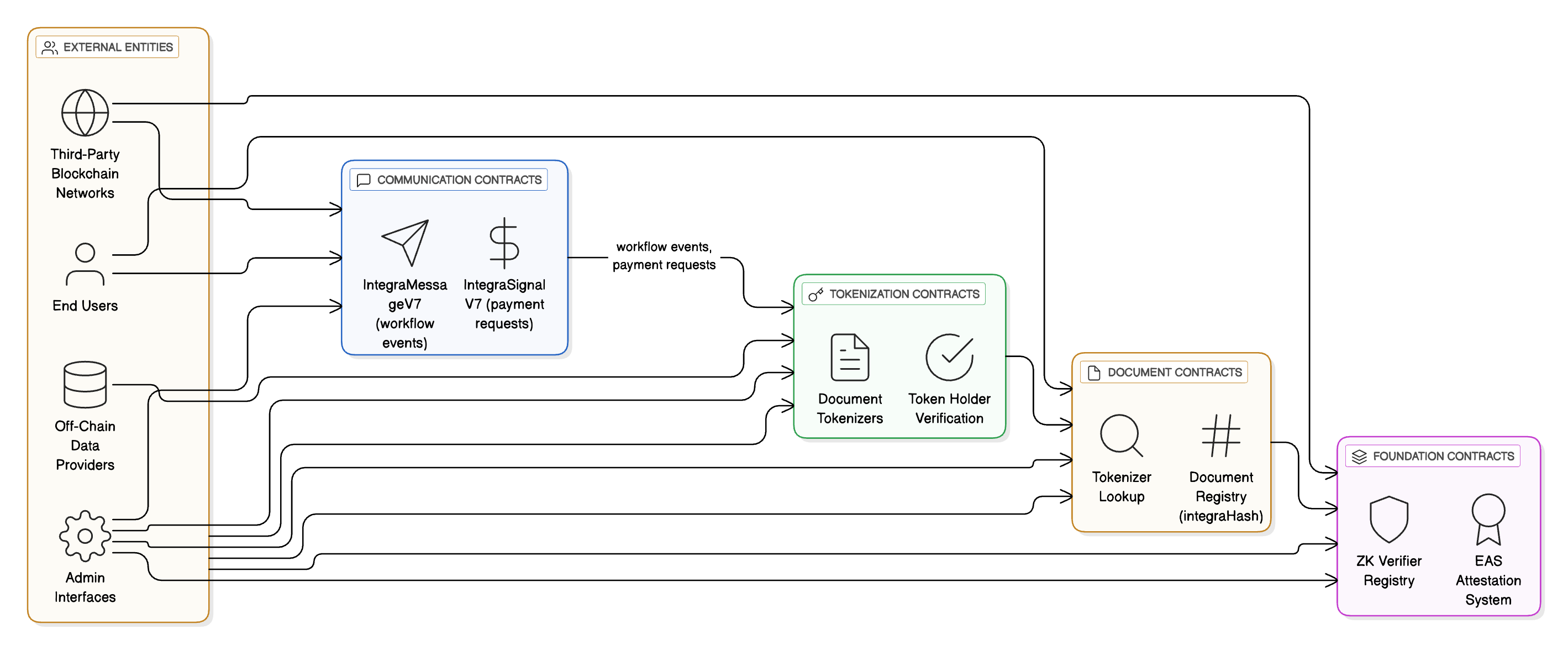
How Contracts Work Together
Cross-Contract Integration
┌─────────────────────────────────────────────────┐
│  Communication Contracts                        │
│  - IntegraMessage (workflow events)           │
│  - IntegraSignal (payment requests)           │
└─────────────────────────────────────────────────┘
                    ↓
┌─────────────────────────────────────────────────┐
│  Tokenization Contracts                         │
│  - Document tokenizers                          │
│  - Token holder verification                    │
└─────────────────────────────────────────────────┘
                    ↓
┌─────────────────────────────────────────────────┐
│  Document Contracts                             │
│  - Document registry (integraHash)              │
│  - Tokenizer lookup                             │
└─────────────────────────────────────────────────┘
                    ↓
┌─────────────────────────────────────────────────┐
│  Foundation Contracts                           │
│  - ZK verifier registry                         │
│  - EAS attestation system                       │
└─────────────────────────────────────────────────┘
Workflow Correlation
processHash = Poseidon(workflowSecret, participants, timestamp)

IntegraMessage:
- Proves knowledge of processHash (ZK proof)
- Emits messages tagged with processHash
- Off-chain indexer groups by processHash

IntegraSignal:
- Includes processHash in payment request
- Emits events tagged with processHash
- Links payments to workflow context
Process Hash Properties:
- Derived from workflow secret (known to participants)
- Poseidon hash (ZK-friendly)
- Correlates events across time
- Privacy-preserving (hash reveals nothing)
Security Model
Defense in Depth
-
ZK Proof Anti-Spam (IntegraMessage)
- Must prove knowledge of processHash
- Prevents random spam messages
- No gas costs for invalid proofs (revert early)
-
Token Holder Verification (IntegraSignal)
- Requestor must hold requestorTokenId
- Payer must hold payerTokenId
- Trust substrate ensures authorized parties
-
Encrypted Payloads (IntegraSignal)
- Payment details never on-chain
- Only requestor + payer can decrypt
- Hybrid encryption scheme
-
EAS Attestation Integrity (IntegraSignal)
- Payload hash attested by EAS
- Prevents payload tampering
- Verifiable integrity
-
State Machine Protection (IntegraSignal)
- Only valid state transitions allowed
- Prevents double-payment
- Timeout mechanism prevents stale requests
Threat Model
Prevented Attacks
| Attack | Prevention Mechanism |
|---|---|
| Message spam | ZK proof requirement |
| Unauthorized payment requests | Token holder verification |
| Payment detail exposure | Encrypted payloads |
| Payload tampering | EAS attestation verification |
| Invalid state transitions | State machine validation |
| Indefinite pending payments | Configurable timeout + extensions |
| Cross-document replay | processHash binding |
| Front-running | EAS recipient binding |
Privacy Guarantees
IntegraMessage:
- Message content encrypted off-chain (if needed)
- processHash reveals no workflow details
- Correlation only possible with processHash knowledge
IntegraSignal:
- Payment amounts encrypted in payload
- Only display amount visible (UI purposes)
- Neither party’s financial details exposed
- Payment proof is hash (no sensitive data)
Gas Optimization
Event-Sourced Design
IntegraMessage:
- No storage writes (only event emission)
- Gas cost: ~60,000-80,000 (with ZK proof verification)
- Scales to unlimited messages (no storage growth)
IntegraSignal:
- Storage only for active payment requests
- Completed payments remain in storage (audit trail)
- Batch operations reduce per-request gas cost
Gas Costs (Approximate)
| Operation | Gas Cost | Notes |
|---|---|---|
| registerMessage() | ~70,000 | Includes ZK proof verification |
| sendPaymentRequest() | ~200,000 | Storage + EAS verification |
| markPaid() | ~50,000 | State update + event |
| cancelPayment() | ~45,000 | State update + event |
| extendPaymentRequest() | ~40,000 | Extension tracking update |
Design Patterns
1. Event-Sourced Communication
- All communication via events (no storage)
- Off-chain indexing for correlation
- Minimizes gas costs
- Enables flexible querying
2. ZK-Based Anti-Spam
- Prove knowledge without revealing secret
- Poseidon-friendly processHash
- BasicAccessV1Poseidon verifier
- Spam prevention without centralized gating
3. Hybrid Encryption
- Session keys encrypted for each party
- AES-256-GCM for payload encryption
- Both parties can decrypt independently
- Privacy-preserving payment details
4. Trust Substrate
- Token holder verification
- Document tokenizers as trust root
- No separate permission system needed
- Leverages existing token infrastructure
5. Configurable Timeouts
- Default timeout: 60 days
- Custom timeout per request (7-365 days)
- Extensions up to 180 days total
- Grace period: 3 hours
Integration Guide
For Workflow Participants
Registering Messages
// 1. Generate ZK proof of processHash knowledge
uint256[2] memory proofA = [...];
uint256[2][2] memory proofB = [...];
uint256[2] memory proofC = [...];

// 2. Register message
integraMessage.registerMessage(
    integraHash,        // Document identifier
    tokenId,            // Your token ID
    processHash,        // Workflow identifier (ZK proven)
    proofA, proofB, proofC,
    "PAYMENT_INITIATED", // Event type
    "Invoice 123 payment started" // Message
);
Creating Payment Requests
// 1. Encrypt payment details
bytes memory encryptedPayload = encryptPaymentDetails(
    paymentAmount,
    currency,
    bankDetails,
    sessionKey
);

// 2. Encrypt session keys
bytes memory encryptedKeyRequestor = encryptForRequestor(sessionKey);
bytes memory encryptedKeyPayer = encryptForPayer(sessionKey);

// 3. Create EAS attestation
bytes32 attestationUID = createPayloadAttestation(
    keccak256(encryptedPayload)
);

// 4. Send payment request
bytes32 requestId = integraSignal.sendPaymentRequest(
    integraHash,
    requestorTokenId,
    payerTokenId,
    payerAddress,
    encryptedPayload,
    encryptedKeyRequestor,
    encryptedKeyPayer,
    attestationUID,
    "INV-2024-001",    // Invoice reference
    1000_00,           // Display amount (100.00 USD)
    "USD",             // Display currency
    processHash,       // Workflow correlation
    30                 // 30-day timeout
);
Marking Payments as Paid
// Either requestor or payer can mark paid
integraSignal.markPaid(
    requestId,
    paymentProofHash,  // Hash of payment receipt
    processHash        // Workflow correlation
);
For Off-Chain Indexers
Indexing Messages
// Subscribe to MessageRegistered events
integraMessage.on("MessageRegistered", (
    integraHash,
    processHash,
    tokenId,
    eventRef,
    message,
    timestamp,
    registrant,
    event
) => {
    // Store in database indexed by processHash
    await db.messages.insert({
        processHash: processHash,
        integraHash: integraHash,
        tokenId: tokenId,
        eventRef: eventRef,
        message: message,
        timestamp: timestamp,
        registrant: registrant,
        blockNumber: event.blockNumber,
        transactionHash: event.transactionHash
    });
});

// Query messages by processHash
async function getWorkflowMessages(processHash) {
    return await db.messages
        .where({ processHash })
        .orderBy('timestamp', 'asc')
        .toArray();
}
Indexing Payment Requests
// Subscribe to PaymentRequested events
integraSignal.on("PaymentRequested", async (
    requestId,
    integraHash,
    requestor,
    payer,
    requestorTokenId,
    payerTokenId,
    attestationUID,
    processHash,
    timestamp,
    event
) => {
    // Fetch full payment request
    const request = await integraSignal.getPaymentRequest(requestId);

    // Store in database
    await db.paymentRequests.insert({
        requestId: requestId,
        processHash: processHash,
        integraHash: integraHash,
        requestor: requestor,
        payer: payer,
        encryptedPayload: request.encryptedPayload,
        displayAmount: request.displayAmount,
        displayCurrency: request.displayCurrency,
        state: 'PENDING',
        timestamp: timestamp
    });
});

// Update on state changes
integraSignal.on("PaymentMarkedPaid", async (requestId, markedBy, paymentProof) => {
    await db.paymentRequests.update(requestId, {
        state: 'PAID',
        paymentProof: paymentProof,
        paidTimestamp: Date.now()
    });
});
For Frontend Developers
Decrypting Payment Requests
// Retrieve payment request
const request = await integraSignal.getPaymentRequest(requestId);

// Determine which session key to use
const isRequestor = request.requestor === userAddress;
const encryptedSessionKey = isRequestor
    ? request.encryptedSessionKeyRequestor
    : request.encryptedSessionKeyPayer;

// Decrypt session key using user's private key
const sessionKey = await decryptWithPrivateKey(
    encryptedSessionKey,
    userPrivateKey
);

// Decrypt payload using session key
const paymentDetails = await decryptAES256GCM(
    request.encryptedPayload,
    sessionKey
);

// paymentDetails now contains:
// - amount
// - currency
// - bank details
// - payment instructions
// - etc.
Best Practices
For Message Senders
- ZK Proof Generation: Generate proofs off-chain to minimize gas
- Message Size: Keep messages concise (max 1000 characters)
- Event References: Use standardized event types for indexing
- Token Verification: Ensure you hold the token before sending
For Payment Request Creators
- Encryption: Use strong encryption (AES-256-GCM)
- Session Keys: Generate unique session key per request
- Display Amounts: Set reasonable display amounts for UI
- Timeouts: Choose appropriate timeout based on payment method
- EAS Attestations: Verify attestation creation before sending request
For Payment Request Recipients
- Decryption: Verify session key integrity before decrypting
- Verification: Validate display amount matches encrypted amount
- Timeouts: Respond before timeout expires
- Extensions: Request extensions if needed before expiry
For Governance
- Default Timeouts: Set reasonable defaults (current: 60 days)
- Extension Limits: Balance flexibility vs. workflow progression
- Monitoring: Track message spam and payment request patterns
- Emergency Pause: Use pause function only for critical issues
Testing Strategy
Unit Tests
- ZK proof verification (valid/invalid proofs)
- Payment request state transitions
- Token holder verification
- Timeout and extension logic
- EAS attestation validation
Integration Tests
- End-to-end message flow
- Payment request lifecycle (PENDING → PAID)
- Multi-party workflows
- Encryption/decryption roundtrip
- Batch payment operations
Security Tests
- ZK proof forgery attempts
- Invalid state transition attempts
- Token holder impersonation
- Replay attack prevention
- Timeout boundary conditions
Resources
Contract Documentation
Related Contracts
External Resources
Version
Current Version: 1.0.0 Solidity Version: 0.8.28 License: MIT
Support
- Security Issues: security@integra.io
- Technical Support: docs@integra.io
- GitHub: https://github.com/IntegraLedger/smart-contracts-evm-v7