Core Concepts
The foundational concepts that make Integra’s Real World Contracts revolutionary.
The Journey
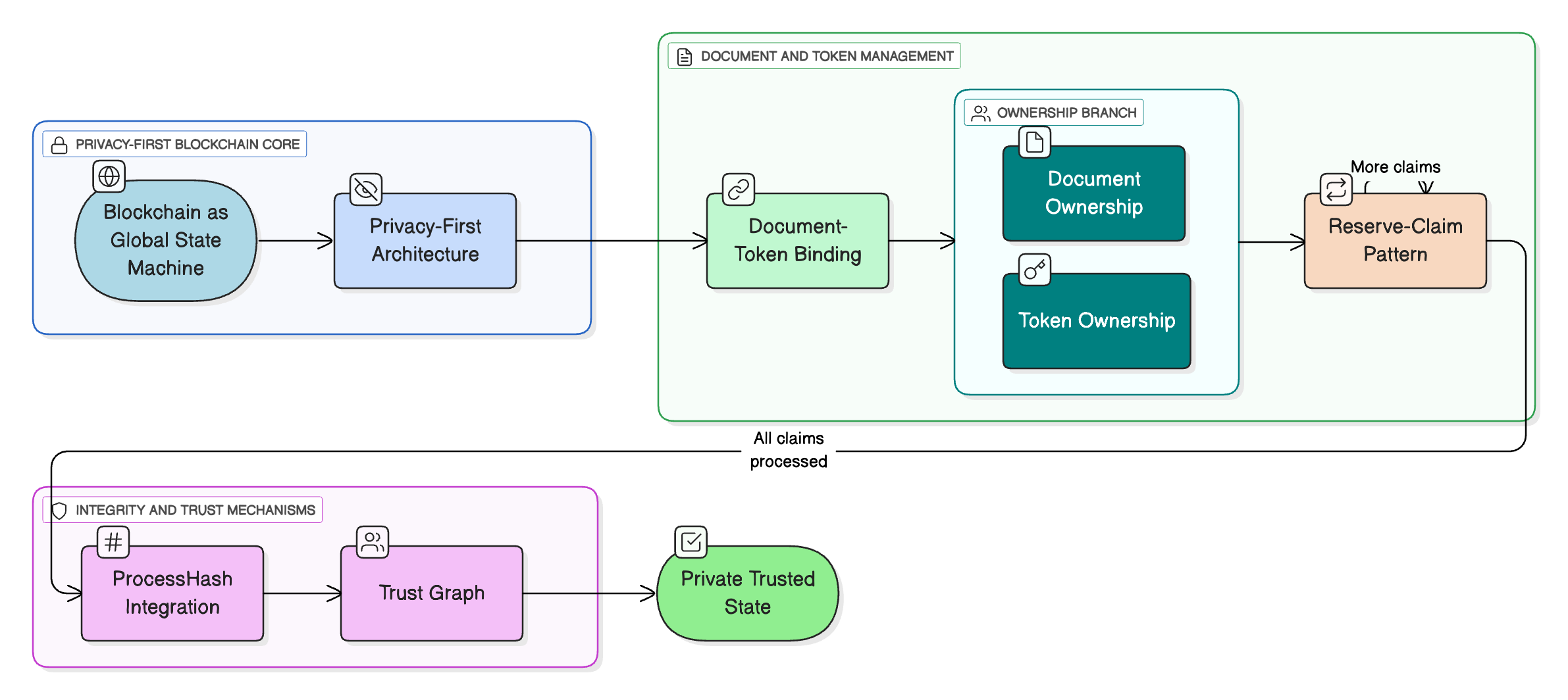
These concepts build on each other - we recommend reading in order:
1. Blockchain as Global State Machine
The revolutionary concept that makes everything possible
How do millions of parties with different software coordinate contract execution without trust or shared systems?
Read: Blockchain as Global State Machine →
2. Privacy-First Architecture
The foundational philosophy: Public proof of private information
Why Integra exists: Enable document automation when privacy policies prohibit sharing.
Read: Privacy-First Architecture →
3. Document-Token Binding
How standard ERC tokens become verifiable real-world assets
The two-layer architecture that permanently binds tokens to cryptographically verifiable documents.
Read: Document-Token Binding →
4. Document vs Token Ownership
The sophisticated dual-ownership model
Document owners ≠ Token holders. Service providers can facilitate without owning. Tokens represent roles and interests, not just assets.
Read: Document vs Token Ownership →
5. Reserve-Claim Pattern
Mainstream blockchain adoption without wallets
How to tokenize agreements with people who don’t have crypto wallets using document-anchored identity.
6. ProcessHash Integration
Universal workflow correlation with any software
Link blockchain events to CRM/ERP/DMS workflows. Integrate with Salesforce, SAP, SharePoint, or any system.
Read: ProcessHash Integration →
7. Trust Graph
Privacy-preserving reputation from blockchain-backed attestations
Build verifiable trust through counterparty-verified contract completion, with selective disclosure.
Why These Concepts Matter
Together, these seven concepts enable:
- ✅ Global coordination across unlimited parties (global state machine)
- ✅ Privacy preservation while automating (public proofs of private info)
- ✅ Verifiable assets not just metadata (document-token binding)
- ✅ Sophisticated workflows with proper separation of concerns (dual ownership)
- ✅ Mainstream adoption without crypto expertise (reserve-claim)
- ✅ Enterprise integration with any software (processHash)
- ✅ Decentralized trust without surveillance (trust graph)
Next Steps
After understanding these concepts:
- Explore Architecture → - See how it all fits together
- View Core Contracts → - The immutable foundation
- Browse Tokenizers → - Economic layer implementations
- Get Started → - Build your first integration