Introducing Real World Contracts
What is Integra?
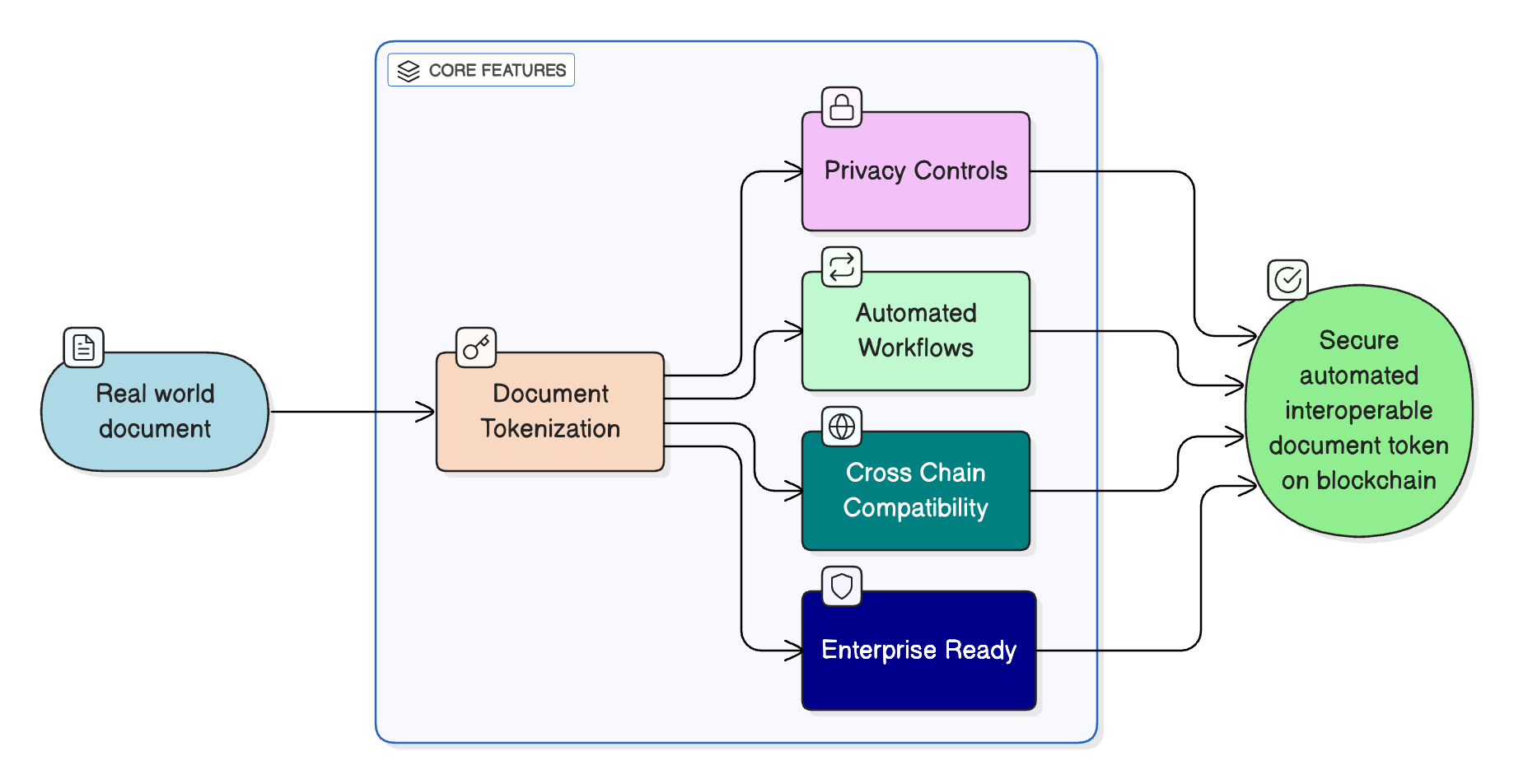
Integra provides blockchain infrastructure for tokenizing real-world documents and assets. Our smart contracts enable you to bring legal documents, certificates, agreements, and other important records onto the blockchain with verifiable ownership, privacy controls, and automated workflows.
What are Real World Contracts?
Real World Contracts (RWC) bridge the gap between physical documents and blockchain technology by transforming static legal agreements, certificates, and asset records into programmable, verifiable digital tokens. Unlike traditional documents that exist as paper or digital files that can be lost, copied, or manipulated, RWCs use blockchain to provide cryptographic proof of ownership, immutable records, and automated execution capabilities. This enables property deeds, rental agreements, credentials, contracts, and other important documents to become tradeable assets with verifiable ownership that anyone can verify but only the true owner can control.
The power of Real World Contracts lies in their ability to solve previously impossible coordination problems while maintaining privacy and security. By using the blockchain as a global state machine, millions of parties with different software systems, security policies, and no prior trust relationship can coordinate contract execution without sharing sensitive documents or requiring direct integrations. Each party keeps their documents in their secure environment and registers only cryptographic proofs (hashes) on the blockchain, enabling privacy-preserving coordination at planetary scale. This approach eliminates the need for centralized databases, point-to-point API integrations, and manual processes while providing permanent, tamper-proof infrastructure that works the same way for decades to come.
The Revolutionary Concept: Blockchain as Global State Machine
Integra uses the blockchain as a global state machine to solve the impossible coordination problem: How do millions of parties with different software, security policies, and no trust coordinate contract execution?
The foundational challenge Integra solves:
Traditional approach: Requires shared systems
  → Cloud collaboration (violates privacy policies)
  → Point-to-point APIs (N² integration problem)
  → Manual processes (doesn't scale)

Integra approach: Blockchain as coordination layer
  → Each party keeps documents private
  → Register proofs (hashes) on global blockchain
  → Use shared identifiers (integraHash, processHash)
  → Any software can read/write global state
  → Ad hoc coordination across unlimited parties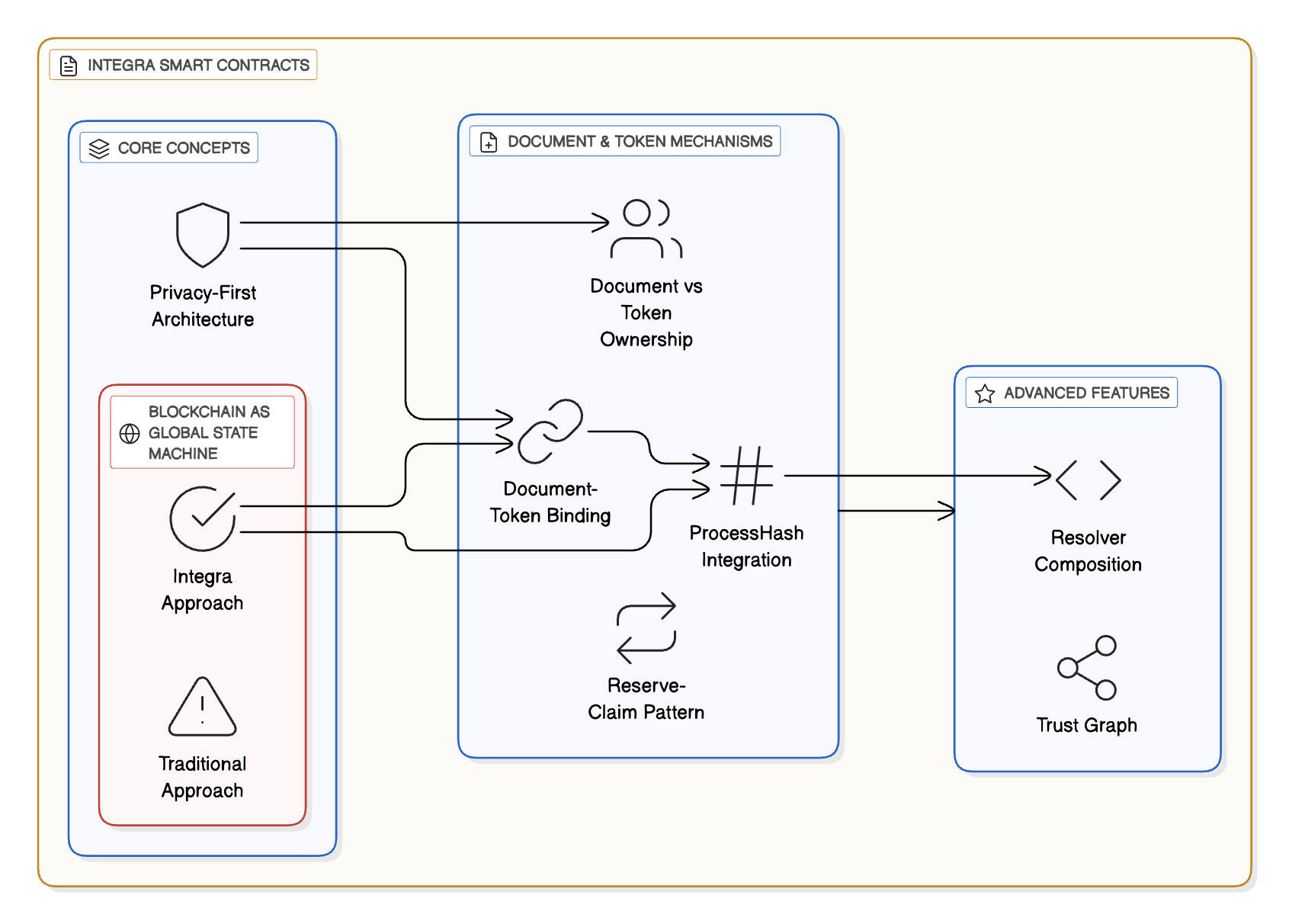
The breakthrough: Privacy-preserving coordination at planetary scale - parties coordinate using blockchain identifiers without sharing documents, using any software, with no direct integrations.
Learn about Blockchain as Global State Machine →
Privacy-First Architecture
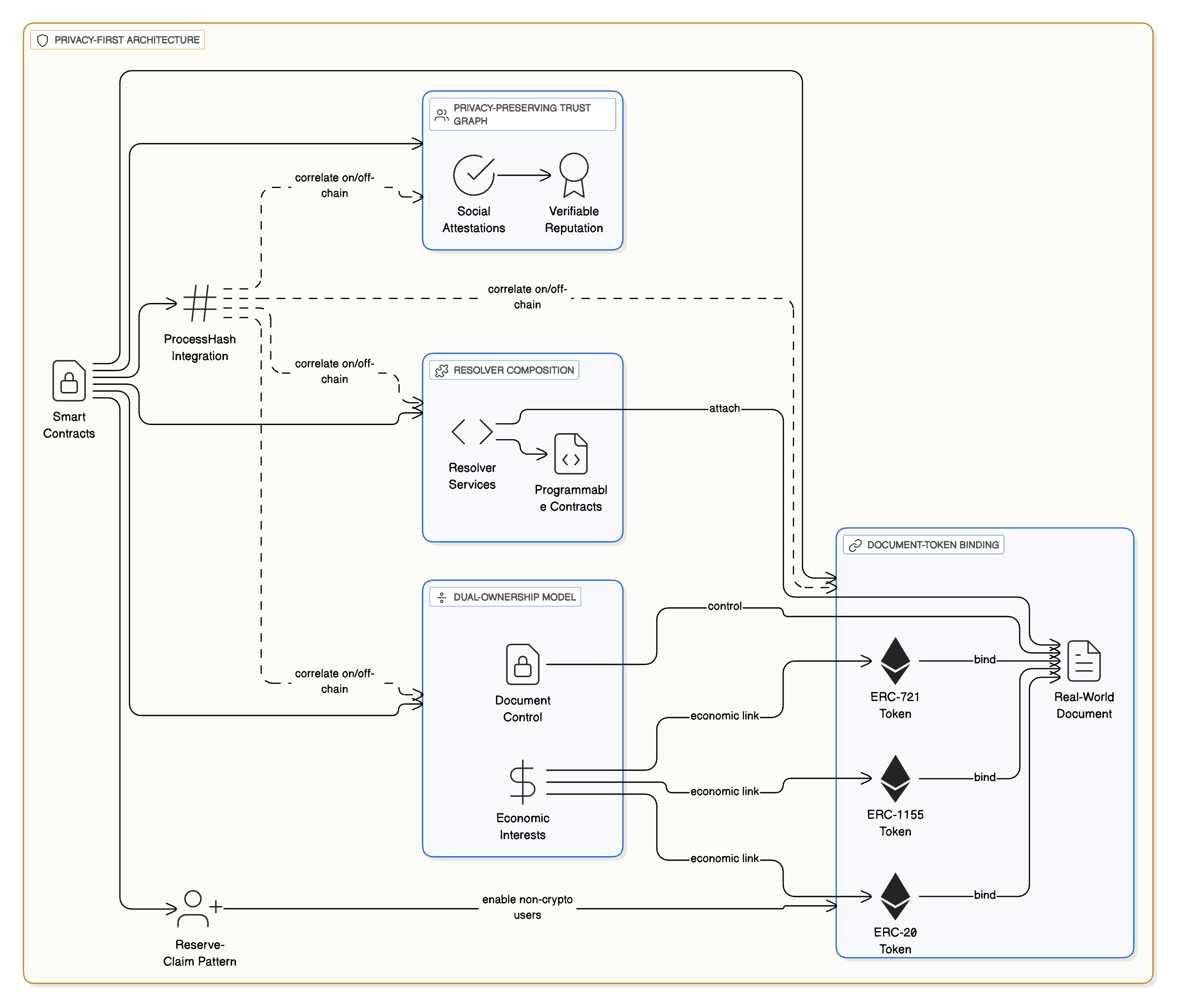
Core principle: Public proof of private information
Integra was born from the need to enable document automation when privacy/security policies prohibit document sharing:
- Document hashes (not content) on blockchain
- Encrypted references (no correlation)
- Random identifiers (no tracking)
- Ephemeral wallets (no identity linking)
- Off-chain identity with on-chain attestations
- Encrypted payments (private financials)
Each party keeps documents in their secure environment, coordinates using blockchain, preserves privacy.
Learn about Privacy Architecture →
The Unique Pattern: Document-Token Binding
Unlike traditional NFTs that only store metadata, Integra uses a two-layer architecture that permanently binds ERC tokens (ERC-721, ERC-1155, ERC-20) to real-world documents:
Document Registry (Layer 1):
- Permanent document identity (integraHash)
- Cryptographic proof of content (documentHash)
- Immutable ownership records
- Service attachment (resolvers)
Tokenizers (Layer 2):
- Standard ERC tokens (work everywhere)
- Bound to document identity
- Verifiable real-world representation
Learn about Document-Token Binding →
Privacy-Preserving Trust Graph
When parties complete real-world contracts, Integra automatically issues social attestations that build verifiable reputation:
How it works:
- Smart contracts automatically attest to participant completion
- Attestations issued to privacy-preserving ephemeral wallets
- Users build trust scores from proven counterparty interactions
- Blockchain-registered contract acts as root credential
Benefits:
- Verifiable reputation (not self-attested)
- Privacy-preserving (selective disclosure)
- Counterparty validated (mutual attestation)
- Portable across platforms
Resolver Composition: Unlimited Extensibility
Transform static documents into programmable contracts by attaching resolver services:
What resolvers enable:
- Automate workflows (expiry, renewal, notifications)
- Enforce compliance (accreditation, jurisdiction, KYC)
- Store metadata (contact info, audit trails)
- Trigger actions (payments, integrations)
- Custom business logic (unlimited possibilities)
The power:
- Attach up to 11 services per document (1 primary + 10 additional)
- Create custom resolvers for your specific needs
- No core contract modifications required
- Mix and match for any use case
Learn about Resolver Composition →
ProcessHash: Universal Application Integration
Every Integra function includes a processHash field that correlates blockchain events with off-chain workflows:
What it enables:
- Link blockchain transactions to CRM/ERP workflows
- Query all blockchain events for a specific business process
- Track multi-step workflows across multiple contracts
- Integrate with any software system (Salesforce, SAP, DocuSign, etc.)
- Maintain audit trails linking on-chain and off-chain
The power:
- Simple correlation mechanism (just include processHash)
- Works across all Integra contracts
- Enables cross-chain workflow tracking
- No additional infrastructure required
Learn about ProcessHash Integration →
Reserve-Claim Pattern: Mainstream Blockchain Adoption
Tokenize agreements with people who don’t have crypto wallets using the reserve-claim pattern:
The challenge solved:
- Most people don’t have crypto wallets
- Traditional blockchain requires wallet addresses upfront
- Can’t tokenize real-world agreements with normal people
Integra’s solution:
- Reserve tokens for recipients (address unknown or known)
- Document serves as identity anchor for all parties
- Create claim attestations (secure authorization)
- Recipients create wallets whenever ready (days, weeks, months later)
- Claim tokens using attestation (self-custody achieved)
The power:
- Onboard mainstream users without crypto expertise
- Anonymous reservations with encrypted labels
- Email/SMS-based claims (familiar UX)
- Gradual adoption (claim when ready)
Learn about Reserve-Claim Pattern →
Document vs Token Ownership: Sophisticated Dual-Ownership Model
Integra separates document control from economic interests - a critical distinction from traditional NFTs:
Document Owner:
- Controls registration, configuration, resolvers, executors
- Often a service provider (law firm, title company, platform)
- NOT necessarily the economic beneficiary
- Can transfer administrative control
Token Holders:
- Hold economic interests and contractual roles
- Represent parties to the agreement (buyer, seller, tenant, guarantor)
- Receive economic benefits and trust credentials
- The actual stakeholders
Executors:
- Automation agents authorized by document owner
- Enable workflow automation without requiring owner transactions
- Backend services, escrow contracts, workflow engines
Philosophy: Integra binds blockchain functionality to traditional contracts - it doesn’t replace them. Tokens represent roles and interests in real-world agreements, not speculative assets for trading.
Learn about Document vs Token Ownership →
Why Smart Contracts Matter
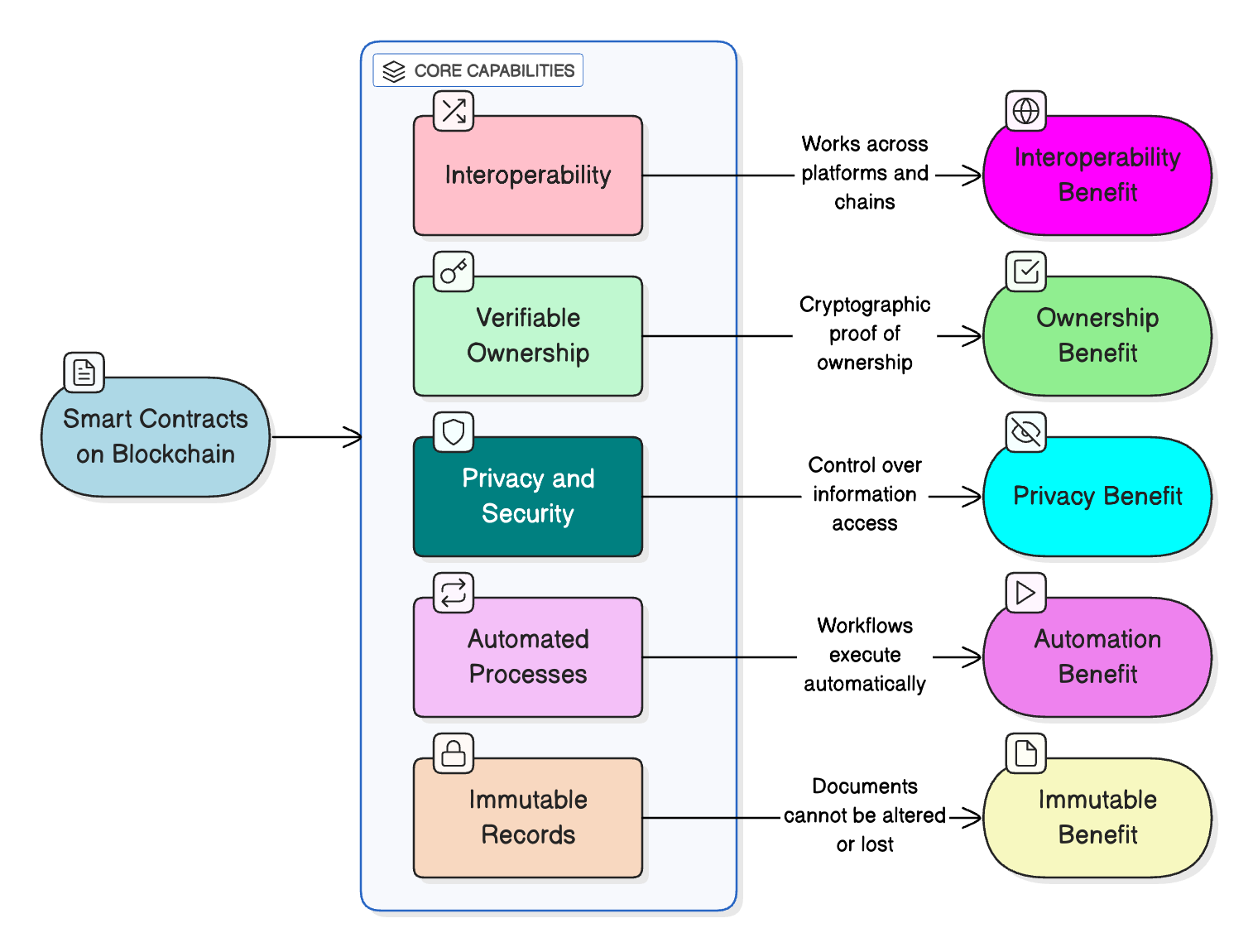
Smart contracts are self-executing programs on the blockchain that run exactly as written, without the possibility of downtime, censorship, fraud, or third-party interference. For real-world documents and assets, this means:
- Verifiable Ownership - Cryptographic proof of who owns what
- Immutable Records - Documents that cannot be altered or lost
- Automated Processes - Workflows that execute automatically based on predefined conditions
- Privacy & Security - Control over who can access your information
- Interoperability - Standards that work across different platforms and chains
Getting Started
Core Features
Document Tokenization
Convert real-world documents into blockchain tokens with verifiable ownership and transfer capabilities.
Privacy Controls
Selective disclosure and encrypted metadata ensure sensitive information stays private while maintaining blockchain transparency.
Automated Workflows
Smart contracts execute business logic automatically - from rent collection to royalty distribution.
Cross-Chain Compatibility
Deploy once, work everywhere. Our contracts run on all major EVM-compatible chains.
Enterprise Ready
Battle-tested patterns, formal verification, and comprehensive security audits.
Use Cases
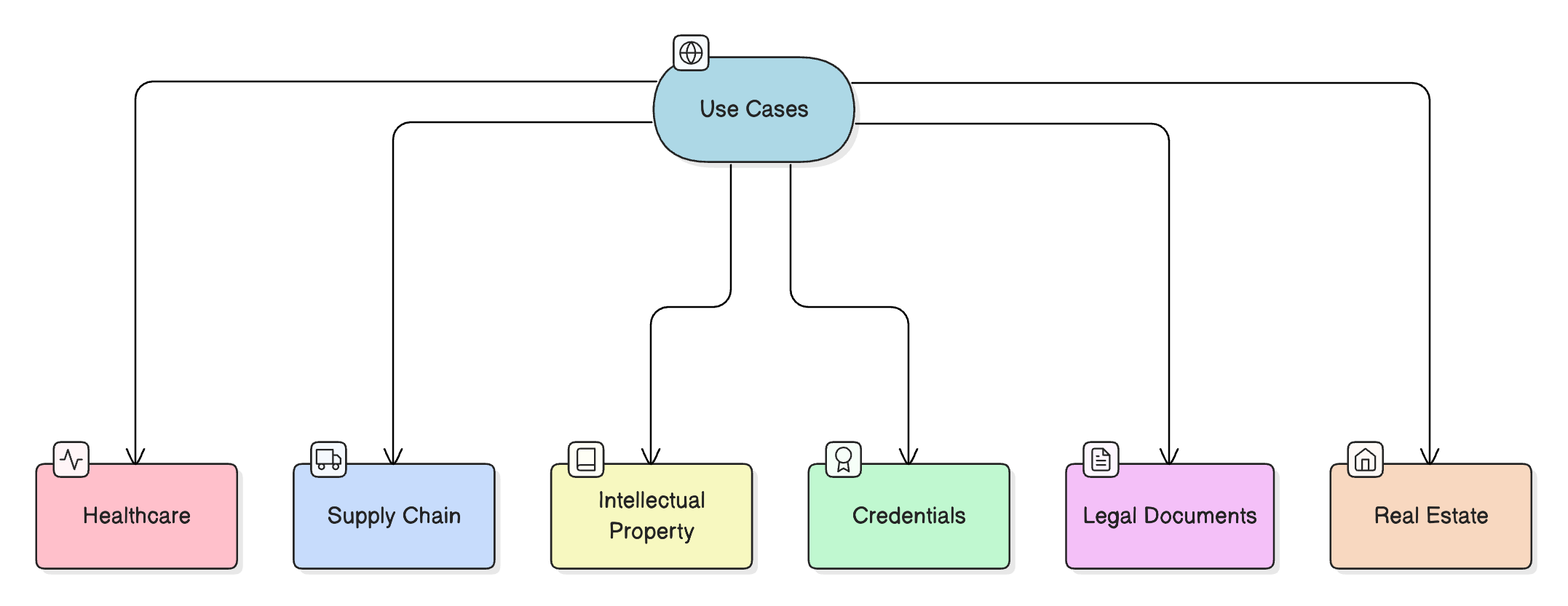
- Real Estate - Property deeds, titles, and rental agreements
- Legal Documents - Contracts, wills, and legal agreements
- Credentials - Certificates, licenses, and diplomas
- Intellectual Property - Patents, copyrights, and royalties
- Supply Chain - Bills of lading, certificates of origin
- Healthcare - Medical records and consent forms
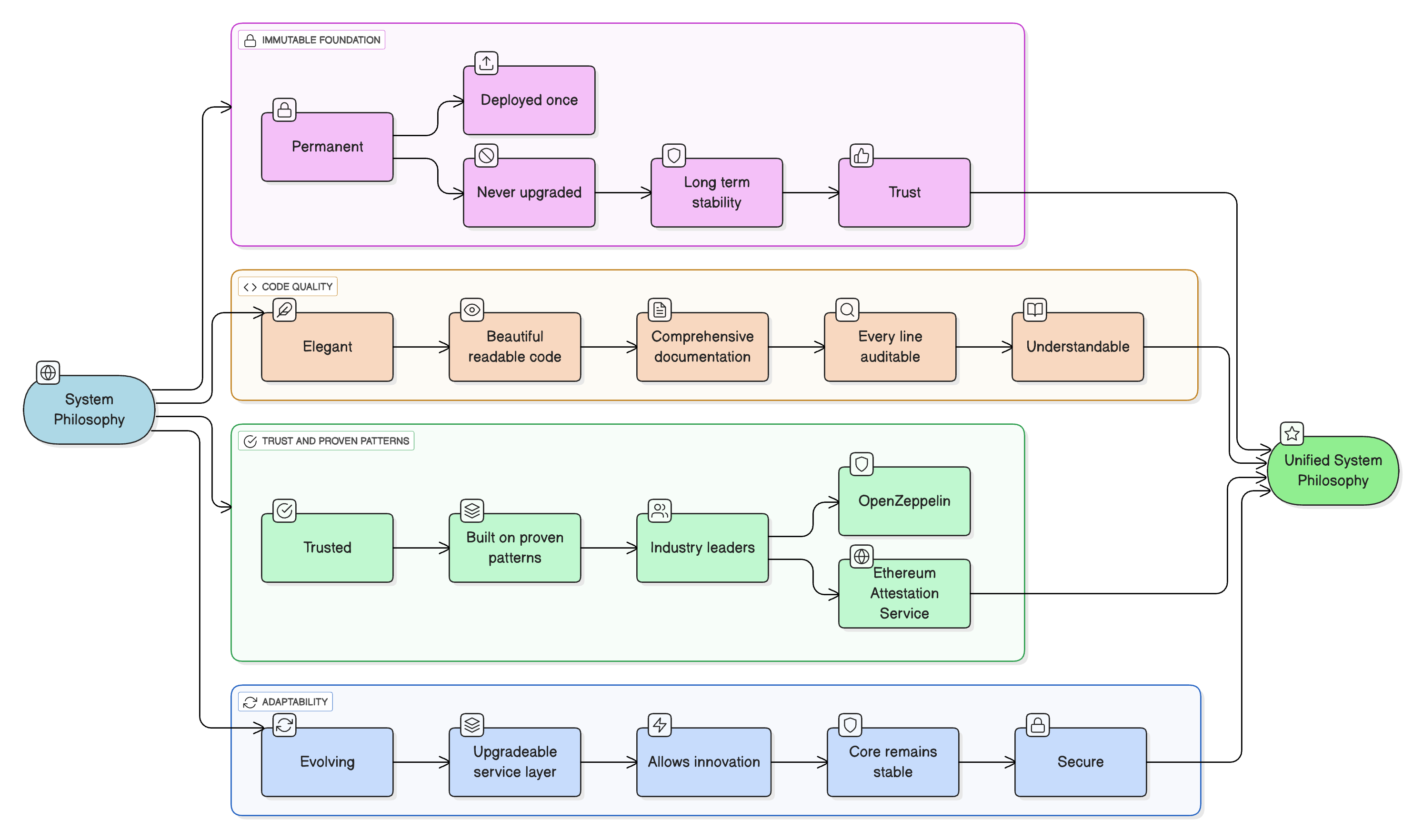
Philosophy
永久 (Permanent)
Our foundation contracts are immutable - deployed once and never upgraded. This provides long-term stability and trust.
優雅 (Elegant)
Beautiful, readable code with comprehensive documentation. Every line is auditable and understandable.
信頼 (Trusted)
Built on proven patterns from industry leaders like OpenZeppelin and EAS (Ethereum Attestation Service).
進化 (Evolving)
Upgradeable service layer allows innovation while the core remains stable and secure.
Next Steps
New to blockchain? Start with Purpose to understand the fundamentals.
Developer? Check out the Architecture and explore Tokenizers.
Ready to dive deep? Explore Core Concepts to understand our revolutionary approach.
Support
- Documentation: You’re here!
- GitHub: github.com/IntegraLedger/smart-contracts-evm-v7
- Security: security@integra.io
- Community: Join our developer community
Welcome to the future of real-world contracts on the blockchain.