Document-Token Binding Pattern
Overview
Integra’s Document-Token Binding Pattern is a novel architecture that connects ERC token standards (ERC-20, ERC-721, ERC-1155) to real-world documents through a permanent registry. This creates tokens that represent verifiable ownership of physical or digital assets - what we call Real World Contracts (RWC).
The Problem with Traditional Tokenization
Traditional NFT/Token Approach
Token Contract
  ├─ tokenId: 1 → metadata URI → JSON
  ├─ tokenId: 2 → metadata URI → JSON
  └─ tokenId: 3 → metadata URI → JSON
Limitations:
- No connection to real-world documents
- Metadata can change or disappear
- No standardized document identity
- No way to attach services (resolvers) to tokens
- Each token contract is isolated
Integra’s Document-Bound Approach
Document Registry (Immutable Identity Layer)
  ├─ integraHash: 0xabc... → Document Record
  │    ├─ documentHash (content proof)
  │    ├─ owner
  │    ├─ tokenizer → OwnershipTokenizer
  │    └─ resolvers (contact, lifecycle, etc.)
  │
  └─ Tokenizer Contract (ERC Standard Layer)
       └─ tokenId: 1 → bound to integraHash: 0xabc...
Benefits:
- Token permanently linked to document identity
- Document can’t be changed (immutable hash)
- Services attach to document, not token
- Standard ERC interfaces work everywhere
- Multiple tokenizers can reference same documents
How It Works
Step 1: Document Registration
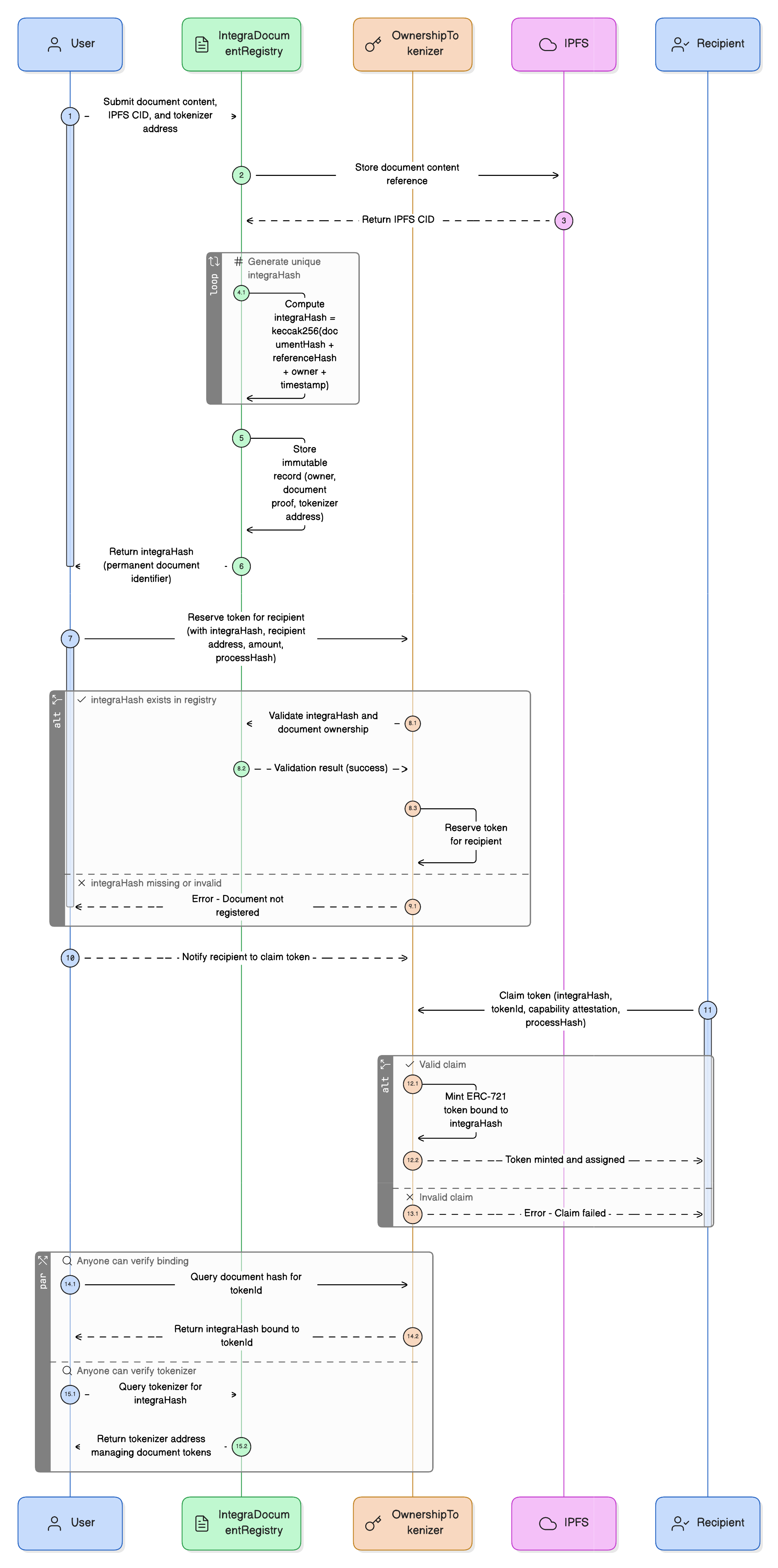
First, a document is registered in the IntegraDocumentRegistry_Immutable:
bytes32 integraHash = documentRegistry.registerDocument(
    keccak256(documentContent),  // documentHash - proves document content
    ipfsCID,                     // referenceHash - where to find document
    address(ownershipTokenizer), // which tokenizer will create tokens
    address(0),                  // optional executor
    bytes32(0),                  // processHash
    bytes32(0),                  // identityExtension
    bytes32(0),                  // primaryResolverId
    new bytes32[](0)            // additionalResolvers
);
What happens:
- System generates unique
integraHash=keccak256(documentHash + referenceHash + owner + timestamp) - Stores immutable record: owner, document proof, tokenizer address
- Returns
integraHashas permanent document identifier
This creates a permanent document identity that:
- Can never be changed
- Proves the document’s content (via hash)
- Links to a specific tokenizer
- Can have services attached (resolvers)
Step 2: Token Creation (Bound to Document)
Now the tokenizer creates ERC tokens bound to the integraHash:
// Owner reserves token for recipient
ownershipTokenizer.reserveToken(
    integraHash,      // Links token to document
    0,                // tokenId (auto-assigned)
    recipientAddress,
    1,                // amount
    processHash
);

// Recipient claims with capability attestation
ownershipTokenizer.claimToken(
    integraHash,              // Token bound to this document
    tokenId,
    capabilityAttestationUID,
    processHash
);
What happens:
- Tokenizer validates
integraHashexists in registry - Tokenizer validates caller is document owner (from registry)
- ERC-721 token minted with internal
integraHashbinding - Token now represents ownership of the real-world document
Step 3: The Binding Lives Forever
The token-document binding is permanent:
// Anyone can verify what document a token represents
bytes32 docHash = tokenizer.getDocumentHash(tokenId);
// Returns the integraHash this token is bound to

// And what tokenizer a document uses
address tokenizerAddr = documentRegistry.getTokenizer(integraHash);
// Returns which tokenizer contract manages this document's tokens
The Architecture
Two-Layer System
Layer 1: Document Identity (Immutable)
IntegraDocumentRegistry_Immutable
  - Pure identity storage
  - Document hash (content proof)
  - Owner address
  - Tokenizer address (which contract creates tokens)
  - Resolver references (services)
  - NEVER changes after creation
Layer 2: Token Standard (ERC-Compliant)
Tokenizer Contract (e.g., OwnershipTokenizer)
  - Implements ERC-721/1155/20
  - Creates tokens bound to integraHash
  - All tokens reference back to document registry
  - Tokens work with any ERC-compatible system
The Binding Mechanism
Each tokenizer stores the integraHash for every token:
// Inside OwnershipTokenizer (ERC-721)
struct TokenData {
    bytes32 integraHash;  // ← Document binding
    address owner;
    bool minted;
    // ... other token data
}

mapping(uint256 => TokenData) private tokenData;
mapping(bytes32 => uint256) public integraHashToTokenId;
This creates bidirectional references:
- Token → Document:
tokenData[tokenId].integraHash - Document → Token:
integraHashToTokenId[integraHash]
Why This Matters
1. Verifiable Real-World Ownership
Traditional NFT:
"This token represents a house"How do you verify? You can’t.
Integra RWC:
Token #123 → integraHash 0xabc...
  → documentHash: 0x def... (SHA-256 of deed)
  → owner: 0x789...
  → registered: 2024-11-18
Anyone can verify the document hash matches the real deed.
2. Tokens Work Everywhere (Standard ERCs)
Because tokenizers implement standard ERCs:
- ✅ Works in MetaMask, Ledger, any wallet
- ✅ Can trade on OpenSea, Blur, any marketplace
- ✅ Composable with DeFi (collateral, lending)
- ✅ Standard transfer/approval mechanisms
But ALSO connected to real documents:
- ✅ Proves what the token represents
- ✅ Links to document services (contact info, lifecycle)
- ✅ Immutable document identity
3. Services Attach to Documents, Not Tokens
Traditional approach:
Each tokenizer must implement resolvers,
contact storage, lifecycle management, etc.
Integra approach:
Document Registry
  └─ integraHash → resolvers
       ├─ Contact Resolver (encrypted contact info)
       ├─ Lifecycle Resolver (expiry, renewal)
       └─ Custom Resolver (your logic)

Any tokenizer for this document can access these services
4. Multiple Tokenization Strategies
Because document identity is separate from tokenization:
// Register document once
bytes32 integraHash = documentRegistry.registerDocument(..., tokenizerA);

// Later, can change tokenization strategy
documentRegistry.setTokenizer(integraHash, tokenizerB);
Example: Start with single-owner token (ERC-721), later fractionalize into shares (ERC-20).
5. Cross-Chain Document Identity
The integraHash is deterministic and can be replicated cross-chain:
Polygon:   integraHash 0xabc... → OwnershipTokenizer (ERC-721)
Ethereum:  integraHash 0xabc... → SharesTokenizer (ERC-20)
Base:      integraHash 0xabc... → MultiPartyTokenizer (ERC-1155)
Same document, different tokenization per chain.
Real-World Example: Property Deed
Step-by-Step Flow
1. Property owner registers deed:
bytes32 deedHash = keccak256(physicalDeedPDF);
bytes32 ipfsCID = "Qm..."; // Uploaded to IPFS

bytes32 integraHash = documentRegistry.registerDocument(
    deedHash,                         // Proves deed content
    ipfsCID,                         // Where to find full deed
    address(ownershipTokenizer),     // Use ERC-721 NFT
    address(0),
    bytes32(0),
    bytes32(0),
    contactResolverId,               // Add contact resolver
    new bytes32[](0)
);
Registry stores:
integraHash:0xabc123...documentHash:0xdef456...(deed SHA-256)owner:0x789...(property owner)tokenizer:0xOwnershipTokenizerresolver: Contact info resolver
2. Owner creates NFT for buyer:
// Reserve deed NFT for buyer
ownershipTokenizer.reserveToken(
    integraHash,     // Links NFT to deed
    0,              // Auto-assign tokenId
    buyerAddress,
    1,
    saleProcessHash
);

// Create claim attestation (via TokenClaimResolver)
bytes32 attestationUID = createClaimAttestation(
    integraHash,
    tokenId,
    buyerAddress
);
3. Buyer claims deed NFT:
ownershipTokenizer.claimToken(
    integraHash,        // Claims token for this deed
    tokenId,
    attestationUID,
    saleProcessHash
);
Result:
- ✅ Buyer now owns ERC-721 token
- ✅ Token permanently bound to deed integraHash
- ✅ Anyone can verify: token → deed hash → actual deed
- ✅ Token works in any ERC-721 wallet/marketplace
- ✅ Contact resolver attached to document
- ✅ Deed ownership on-chain, verifiable, transferable
Verification by Third Party
Anyone can verify the token represents the real deed:
// 1. Get integraHash from token
bytes32 integraHash = ownershipTokenizer.getDocumentHash(tokenId);

// 2. Look up document in registry
(address owner, bytes32 documentHash, , , ) =
    documentRegistry.getDocumentInfo(integraHash);

// 3. Compare documentHash with actual deed
bytes32 actualDeedHash = keccak256(physicalDeedPDF);
require(documentHash == actualDeedHash, "Deed doesn't match!");

// 4. Verified: This token definitely represents this deed
Comparison with Other Approaches
Approach 1: Metadata-Only NFTs (OpenSea standard)
Token → tokenURI → { "name": "My House", "description": "..." }Problems:
- ❌ No proof of document authenticity
- ❌ Metadata can change
- ❌ No services (resolvers)
- ❌ No real-world document link
Approach 2: Document Hash in NFT
Token → metadata includes documentHashBetter, but:
- ❌ Each tokenizer reinvents the wheel
- ❌ No standardized document identity
- ❌ No resolver services
- ❌ Can’t change tokenization strategy
Approach 3: Integra Document-Token Binding
Document Registry (integraHash) ↔ Tokenizer (ERC tokens)Advantages:
- ✅ Permanent document identity
- ✅ Cryptographic document proof
- ✅ Standard ERC tokens (universal compatibility)
- ✅ Resolver services
- ✅ Flexible tokenization
- ✅ Cross-chain support
Technical Benefits
For Smart Contract Developers
1. Reusable Document Identity
// Use integraHash across multiple contracts
contract MyContract {
    function processDocument(bytes32 integraHash) external {
        // Verify document exists
        require(documentRegistry.exists(integraHash));

        // Get document owner
        address owner = documentRegistry.getDocumentOwner(integraHash);

        // Get tokenizer
        address tokenizer = documentRegistry.getTokenizer(integraHash);

        // Your custom logic...
    }
}
2. Composability with DeFi
// Use as collateral (because it's standard ERC-721)
lendingProtocol.depositCollateral(tokenId);

// But backed by real document
bytes32 integraHash = tokenizer.getDocumentHash(tokenId);
bytes32 documentHash = documentRegistry.getDocumentHash(integraHash);
// Can verify collateral is real property deed
3. Service Discovery
// Get contact info for document holder
bytes32 integraHash = tokenizer.getDocumentHash(tokenId);
bytes32 resolverId = documentRegistry.getPrimaryResolver(integraHash);
address resolver = integraRegistry.getComponent(resolverId);
bytes memory contactData = IDocumentResolver(resolver).resolve(integraHash);
For Application Developers
1. Standard Wallet Integration
- Tokens are standard ERC-721/1155/20
- Work in MetaMask, WalletConnect, etc.
- No custom wallet support needed
2. Marketplace Integration
- List on OpenSea, Blur, etc.
- Standard approval/transfer mechanisms
- But can show real document verification
3. Document Verification
- Query registry for document proof
- Show “Verified Document” badge
- Link to IPFS for full document
Advanced Patterns
Pattern 1: Multi-Tokenizer Documents
One document, multiple tokenization strategies:
// Polygon: Single owner (ERC-721)
documentRegistry.registerDocument(
    documentHash,
    ipfsCID,
    ownershipTokenizer,  // ERC-721
    ...
);

// Ethereum: Fractionalized (ERC-20)
// Use same documentHash + owner = same integraHash cross-chain
documentRegistry.registerDocument(
    documentHash,        // Same hash
    ipfsCID,            // Same reference
    sharesTokenizer,    // ERC-20 for fractions
    ...
);
Pattern 2: Document Evolution
Start simple, evolve over time:
// Phase 1: Simple NFT ownership
registerDocument(..., ownershipTokenizer);

// Phase 2: Add rental capability
documentRegistry.setTokenizer(integraHash, rentalTokenizer);

// Phase 3: Add royalty distribution
documentRegistry.setTokenizer(integraHash, royaltyTokenizer);
Pattern 3: Service Composition
Add services to documents without changing tokenizer:
// Start with basic document
registerDocument(..., basicTokenizer, NO_RESOLVER);

// Later: Add contact resolver
documentRegistry.setPrimaryResolver(integraHash, contactResolverId);

// Later: Add lifecycle resolver
documentRegistry.addAdditionalResolver(integraHash, lifecycleResolverId);

// Later: Add payment automation
documentRegistry.addAdditionalResolver(integraHash, paymentResolverId);
Security Considerations
Immutable Document Hash
Once registered, the documentHash can never change:
- ✅ Permanent proof of document content
- ✅ Can’t be tampered with
- ✅ Historical verification possible
Tokenizer Validation
Tokenizers must validate with registry:
// Inside tokenizer
function _validateDocument(bytes32 integraHash) internal view {
    require(documentRegistry.exists(integraHash), "Document not found");
    require(
        documentRegistry.getTokenizer(integraHash) == address(this),
        "Wrong tokenizer for document"
    );
}
Owner Controls
Document owner controls:
- Who can claim tokens (via attestations)
- Which resolver services are attached
- Executor authorization
- But CANNOT change document hash
Summary
Integra’s Document-Token Binding Pattern:
- Separates document identity from tokenization
- Links ERC tokens to permanent document records
- Enables standard wallet/marketplace compatibility
- Provides verifiable proof of real-world asset ownership
- Supports flexible tokenization strategies
- Allows services to attach to documents
- Works cross-chain with consistent identity
This is what makes Integra’s tokens Real World Contracts - they’re not just NFTs with metadata, they’re cryptographically bound to verifiable real-world documents with permanent on-chain identity.